
Spain is part of the European Union, and this status radically changes the game for travelers wishing to bring back perfume. Unlike tobacco or alcohol, perfume is not subject to any published quantitative threshold by French customs for intra-EU travel. The regulation relies on a more vague criterion, that of personal use, which creates an area of interpretation that online competitors rarely address in depth.
Perfume and intra-EU customs: why no official threshold exists
For tobacco and alcohol, the General Directorate of Customs and Indirect Taxes publishes precise indicative quantities (packs of cigarettes, liters of wine, liters of spirits). These thresholds serve as benchmarks beyond which the traveler must prove the personal use of their purchases.
For perfume, the situation is different. No specific threshold is published for perfumes coming from an EU member country. French customs reason based on the consistency between the quantity transported, the duration of the stay, and the absence of signs of resale. Bringing back three or four bottles for oneself or as gifts does not pose any practical difficulty.
On the other hand, a suitcase containing several dozen identical bottles could trigger a check. The customs officer will then seek to establish whether the purchase is for personal use or for commercial importation. This criterion applies to all products outside tobacco and alcohol, including cosmetics and perfumes. To find out how much perfume to bring back from Spain according to Voyagoo, one must therefore reason in terms of likelihood rather than in terms of a quantified quota.
Air transport of perfume from Spain: the forgotten constraint
Most articles on the subject focus on customs rules. The real bottleneck often lies elsewhere: at the airport security check, even before boarding.
Cabin rules for liquids
The air safety regulations applied in the EU impose a strict restriction on liquids transported in cabin baggage. Each bottle must not exceed 100 ml, and all containers must fit into a resealable transparent plastic bag with a maximum capacity of one liter.
A 200 ml bottle of perfume, even half-empty, will be refused at the security check if you attempt to take it into the cabin. This point is often a source of confusion: customs does not prohibit this bottle, but airport security does.
The solution of checked baggage
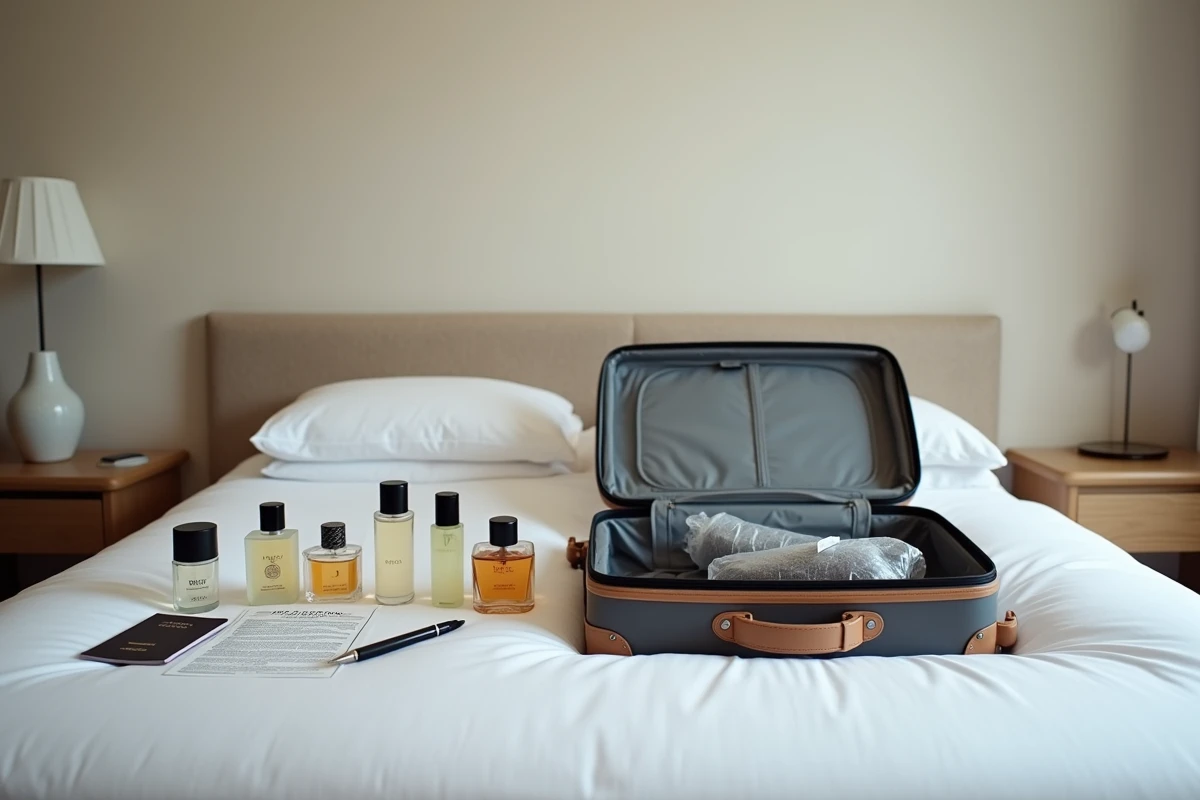
Bottles of perfume placed in checked baggage are not subject to the 100 ml limit. This is the simplest method for bringing back larger containers. A few precautions are necessary:
- Wrap each bottle individually in bubble wrap or thick clothing to absorb shocks
- Place the bottles in a leak-proof bag, such as a freezer bag, to prevent any leakage from spreading in the suitcase
- Avoid storing perfumes near electronic devices or fragile clothing
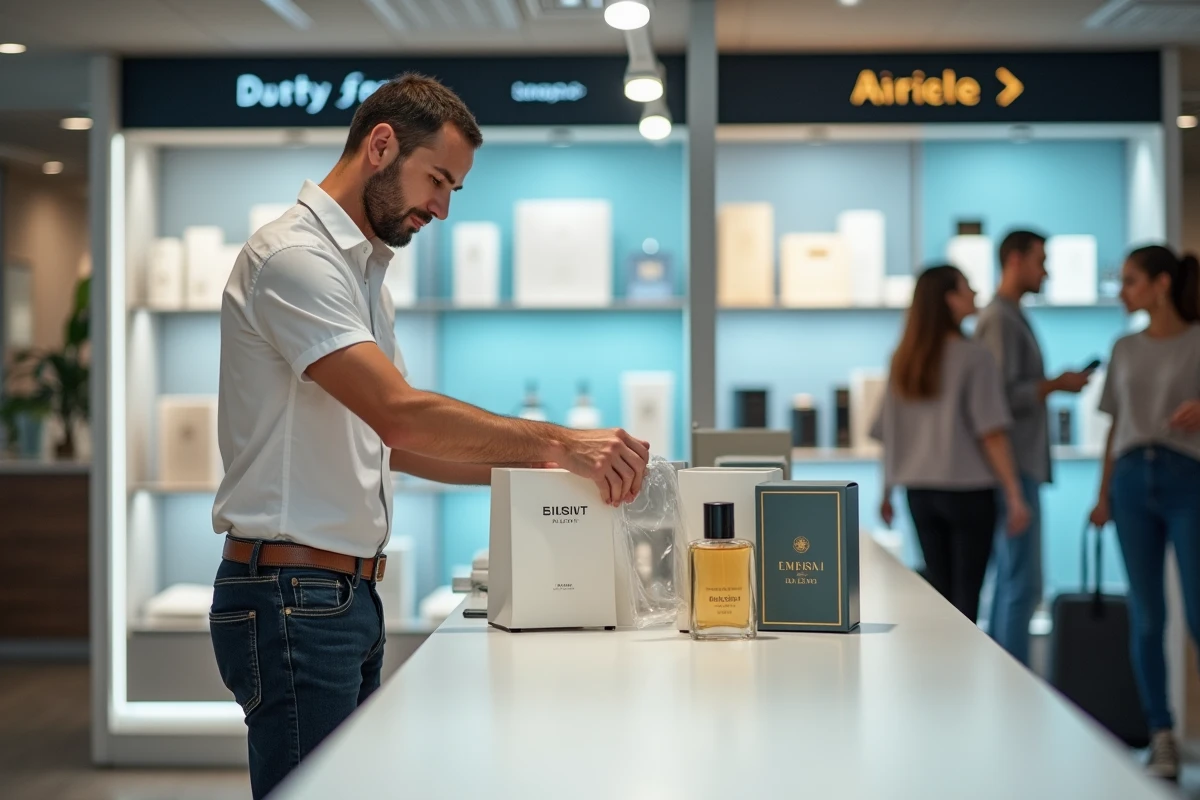
Duty-free purchases do not change the security rules. A perfume purchased in a duty-free shop at a Spanish airport can be taken into the cabin in a sealed bag provided by the seller, as long as this bag is not opened before arrival. If you have a connecting flight with a new security check, the sealed bag may sometimes pose a problem depending on the airports.
Return from Spain by road: a more flexible framework for perfume
Land transport removes the air constraint on liquids. By car, there is no limit on the size of each bottle nor an obligation for a transparent bag. Only the criterion of personal use applies for travel between two EU countries.
Customs checks at intra-EU land borders are random. They mainly focus on tobacco and alcohol, products subject to excise duties and for which price discrepancies between France and Spain motivate bulk purchases. Perfume attracts much less attention from customs services in this context.
If you return from Andorra (which is not an EU member) after a detour from Spain, the rules change. The duty-free allowance for travelers coming from a third country then applies, with a value ceiling per person beyond which goods must be declared. The allowance is 300 euros per person for land transport and 430 euros for air or sea transport.
Perfume from Spain and suspicion of resale: what customs checks
The absence of a quantified threshold for perfume does not mean the absence of control. Customs has criteria for distinguishing a personal purchase from a disguised commercial import.
- The quantity brought back in relation to the number of travelers (twenty bottles for a single person will be difficult to justify)
- The presence of multiple copies of the same product, of the same size or reference
- The existence of invoices or proof of purchase suggesting a regular supply activity
- The behavior of the traveler and the consistency of their statements with the duration and nature of the stay
In the event of reclassification as a commercial import, goods may be seized and customs duties applied. Field returns vary on this point: some travelers report having crossed the border with a dozen bottles without difficulty, while others mention checks for comparable quantities. The margin of appreciation remains at the discretion of the customs officer.
The common-sense rule is to keep receipts, not to transport manifestly disproportionate quantities, and to be able to simply explain the destination of each product. A group purchase for family gifts remains personal use, as long as the volumes remain reasonable in relation to the number of people involved.
Spanish perfume is not subject to any additional tax upon return to France as long as the purchase remains within the private framework. VAT has already been paid in Spain, an EU member country, and no declarative formalities are required. For travelers returning from Andorra or the Canary Islands (territories outside the EU tax regime), the value allowance per person becomes the determining criterion again.