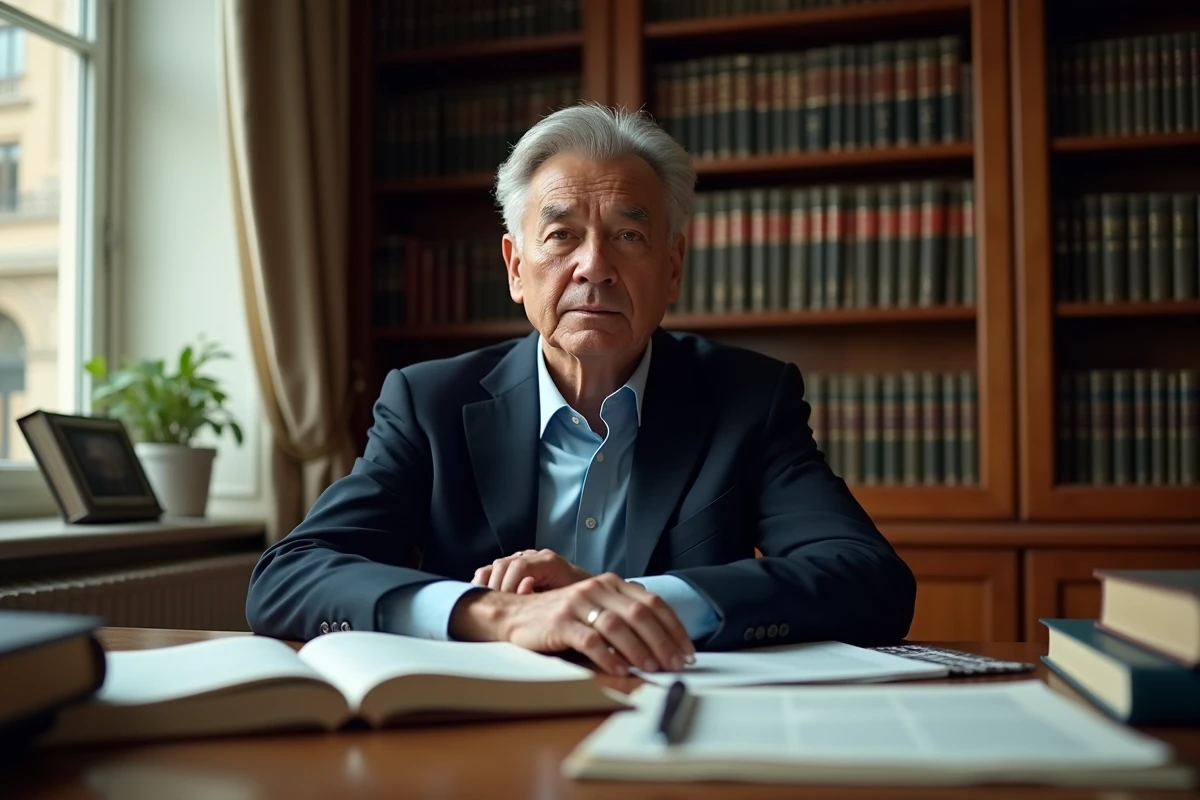
Alain Bauer is a professor of criminology at the Conservatoire national des arts et métiers (CNAM), a consultant sought by several French governments on security and delinquency issues. His name regularly appears in mainstream media, official reports, and televised debates. However, his family life remains a virtually total documentary blind spot.
Alain Bauer and his private life: a rare documentary silence for a public figure
Institutional biographical notices, publisher profiles, and academic profiles dedicated to Alain Bauer share a striking commonality: no public mention of children or family life. The available information is limited to his origins (son of Georges Bauer and Monique Ejzenberg) and his professional background.
This observation contrasts with the usual treatment reserved for other media experts of comparable notoriety. The press often mentions the partner or children of public figures who participate with similar frequency in national debate. In Bauer’s case, this aspect is systematically absent.
Several sources indicate that he may be married to Brigitte Henri, a magistrate. Beyond this information, the intimate sphere remains deliberately opaque, which constitutes a conscious image management choice rather than a mere media oversight. A more detailed portrait on the family and children of Alain Bauer allows us to gauge the gap between his public presence and the few elements available about his personal life.
Privacy protection in France: the legal framework that applies to the families of public figures
French law protects the privacy of every individual, including that of the relatives of public figures. Article 9 of the Civil Code establishes the principle of respect for private life, and case law has strengthened the protection of minors against non-consensual media exposure.
For a criminologist who regularly appears on television and in print media, this protection takes on a practical dimension.
- The dissemination of images or information about the children of a public figure without parental consent exposes one to civil lawsuits, even if the parent is a media figure themselves.
- The media covering Alain Bauer’s interventions respect an implicit pact of non-exposure of his private sphere, including his most virulent detractors.
- The criticisms directed at Bauer focus exclusively on his academic titles, institutional networks, and public positions, never on a familial or intimate aspect.
This last point deserves attention. In the recurring controversies over his legitimacy as a “specialist” or “criminologist,” no opponent has attempted to exploit a familial angle. This suggests either a lack of exploitable information or a shared respect for this boundary.
Alain Bauer’s discretion: image strategy or personal conviction
Alain Bauer’s discretion regarding his family is not a mere coincidence. An expert in security advising governments on delinquency and terrorism has concrete reasons to limit the exposure of his loved ones.
The reputational risk is the primary factor. Any personal information made public can be weaponized in a contentious debate. By providing no leverage on his family life, Bauer reduces the attack surface for his media or political adversaries.
The second factor is operational. A specialist working on sensitive cases (terrorism, organized crime, intelligence) potentially exposes his loved ones to risks if their identity becomes public. This reality also concerns other experts in the same field, but few maintain such strict compartmentalization over time.
Separation between expert posture and parental experience
In his most recent interventions on juvenile justice and child protection, Alain Bauer speaks of children exclusively as objects of criminal policy and social protection. During his statements on the Lyhanna case, for example, he has never invoked personal parental experience to support his analysis.
This separation is methodical. Where other public commentators readily invoke their experiences as parents to legitimize a position on youth or education, Bauer adheres to an analytical posture. This choice enhances his credibility as a technical expert, but it also fuels curiosity about his actual family situation.

Media exposure and family life: what the Bauer case reveals about French personalities
The media treatment of Alain Bauer illustrates a tension inherent in the French landscape. Public figures who frequently appear in the media face increasing pressure for personal transparency, driven by social media and interview formats seeking the human angle.
Bauer resists this pressure with notable effectiveness. His public engagement remains strictly confined to the professional realm. The shows that invite him do not attempt to breach this limit, which in itself is an indicator of the power dynamics he has established with the editorial teams.
This image management could serve as a case study for other public figures facing the same dilemma. The strategy relies on consistency: a single breach in the compartmentalization of public life and private life is enough to open a media airlock that is difficult to close.
- No family photos have circulated in the press or on social media.
- No interview has directly addressed the subject of his children or his couple.
- The silence has been maintained in the same way for several decades of active public life.
Alain Bauer’s journey shows that strict compartmentalization between public life and family sphere remains possible in France, even for a highly exposed personality. This outcome is less due to the law than to a personal discipline applied without exception, even in the face of the most intrusive media formats.