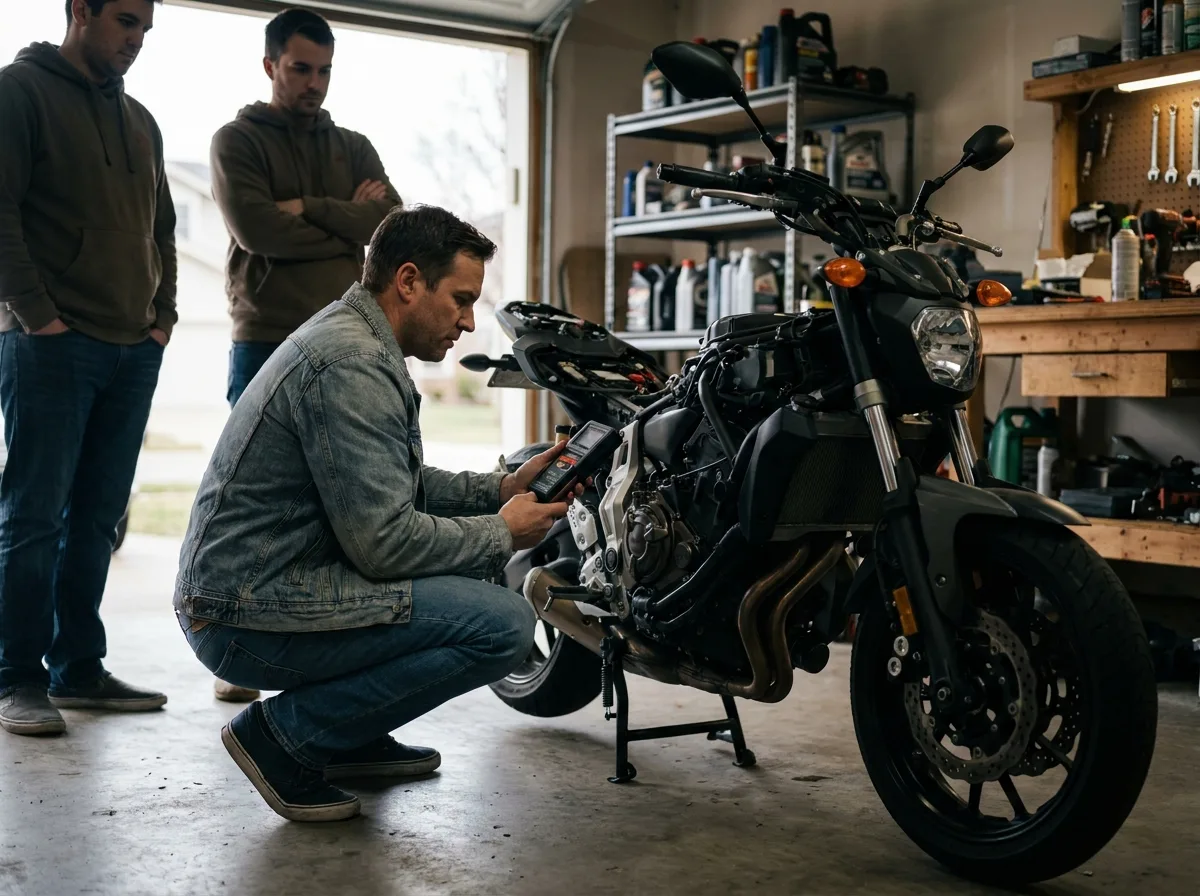
A friend asks to borrow your motorcycle for the weekend. Before handing over the keys, the question of the battery deserves more than a vague “it’s charged.” An occasional user who is not familiar with your machine’s habits can, in just a few days, compromise the health of a battery you have maintained for months. Here are the technical points to check and the instructions to convey to ensure you get your motorcycle back with an intact battery.
Resting Voltage and State of Charge: The Diagnosis Before Lending
We recommend measuring the open-circuit voltage with a multimeter before handing over the keys. A conventional 12 V lead-acid battery should show at least 12.6 V at rest (engine off for at least two hours). Below 12.4 V, the battery is already partially discharged, and repeated starts by an unfamiliar driver will accelerate the sulfation of the plates.
On a lithium-ion (LiFePO4) battery, the critical threshold is different: the nominal voltage is around 13.2 V when fully charged, and the integrated BMS cuts off below a certain level to protect the cells. Lending a motorcycle equipped with a partially discharged lithium battery exposes it to a complete cut-off of the BMS, which the borrower will interpret as an electrical failure.
In practice, if the voltage is borderline, plug in a smart charger the night before lending. A few hours are enough to bring a healthy battery back to full capacity. Also, remember to check the motorcycle insurance and the guarantees related to the loan, as the insurance framework changes as soon as a third party takes the handlebars.
Parasitic Consumers and Kill Switch: What to Disable Before Lending
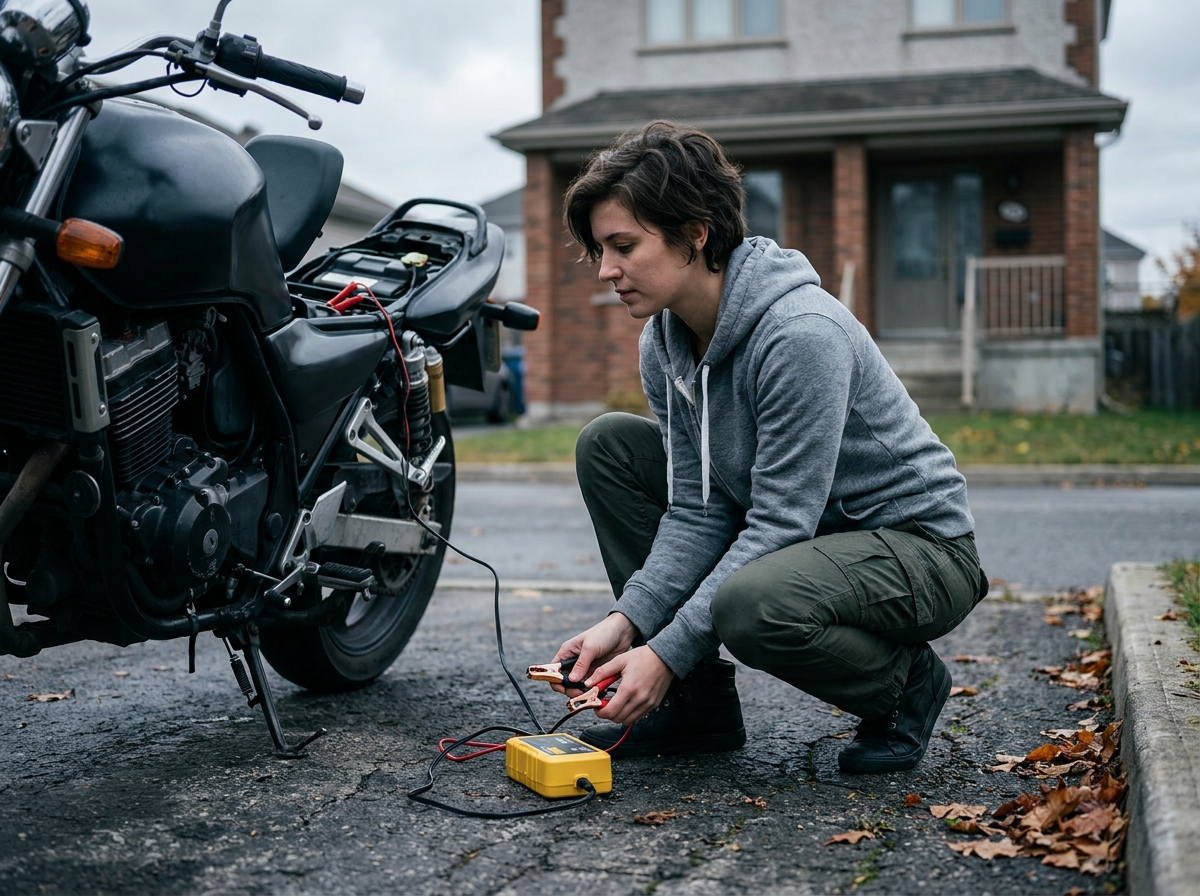
One point that classic maintenance guides never address in the context of lending: the parasitic consumers specific to your setup. GPS tracker, permanent USB socket, aftermarket alarm, dashboard clock—these devices draw power even when the ignition is off. You know their impact on your daily use, but your friend may not realize that they need to unplug the auxiliary socket or disable the tracker during prolonged parking.
If your motorcycle has a battery kill switch, show the borrower how to operate it. For machines that do not have one, a clear instruction is sufficient: do not leave the ignition on “accessories” during a stop, even a brief one.
Points to Communicate to the Borrower
- The location of the kill switch or the procedure to cut off the auxiliaries (GPS, 12 V socket, alarm) when the motorcycle is parked for more than an hour
- The normal behavior of the starter when cold on your engine (number of attempts before waiting, maximum duration of a starting cycle)
- The prohibition of forcing the starter beyond a few seconds, which overheats the circuit and can damage the battery plates
- The fact that trips of less than ten minutes do not recharge the battery significantly, especially in the city with headlights, turn signals, and fan running
These instructions may seem obvious to an experienced rider. They are not for someone who rides rarely or usually operates a different type of machine.
One-Time Loan or Regular Use: The Impact on the Battery Changes Radically
A weekend loan does not have the same consequences as a loan of several weeks. With prolonged use, the friend effectively becomes a secondary driver in the eyes of insurers, but the technical impact on the battery is just as significant.
A borrower who uses the motorcycle for short commute trips will repeatedly start and stop without ever allowing the alternator time to compensate for the starter’s consumption. On a conventional lead battery, a few weeks of this regimen are enough to establish irreversible sulfation on the plates.
If the loan exceeds a few days, we recommend providing a maintenance charger with the motorcycle. Smart models with temperature compensation are inexpensive and prevent deep discharge that kills lead batteries. The borrower just needs to plug in the charger every night, just like charging a phone.

Terminals and Connectors: Grease and Tighten Before Handing Over the Keys
Terminal oxidation is the quintessential invisible problem. A thin layer of sulfate on the terminals increases the internal resistance of the circuit, reducing the voltage available to the starter and giving the impression that the battery is weak when it is properly charged.
Before lending, clean the terminals with a wire brush or fine sandpaper, then apply a thin layer of dielectric grease. Check the torque: a terminal that moves by hand causes micro-cuts and electrical arcs that can damage the connectors over time.
Visual Inspection of the Wiring and Fuses
Take the opportunity to inspect the visible wiring around the battery. A cable with a cracked sheath or a blackened fuse indicates a latent short circuit. It’s better to discover this before the loan than to receive a call from your friend on the side of the road.
Also check the electrolyte level if your battery is of the conventional type with caps. A dry cell heats up, loses capacity, and can swell. Maintenance-free batteries (AGM, gel) do not require this check, but they are even less tolerant of deep discharge.
Recovering the Motorcycle: The Check Upon Return
Upon return from the loan, do not just turn the key. Measure the resting voltage again and compare it with the value recorded before the loan. A difference of more than a few tenths of a volt suggests that the battery has undergone a significant discharge.
If the voltage is low, a full charge on a smart charger before hitting the road again protects the longevity of the accumulator. A battery recharged within hours after a discharge regenerates much better than a battery left flat for several days.
Lending a motorcycle remains a gesture of trust. Adding five minutes for battery checks before and after does not complicate anything, and it saves you from discovering a starter that spins in vain on Monday morning.