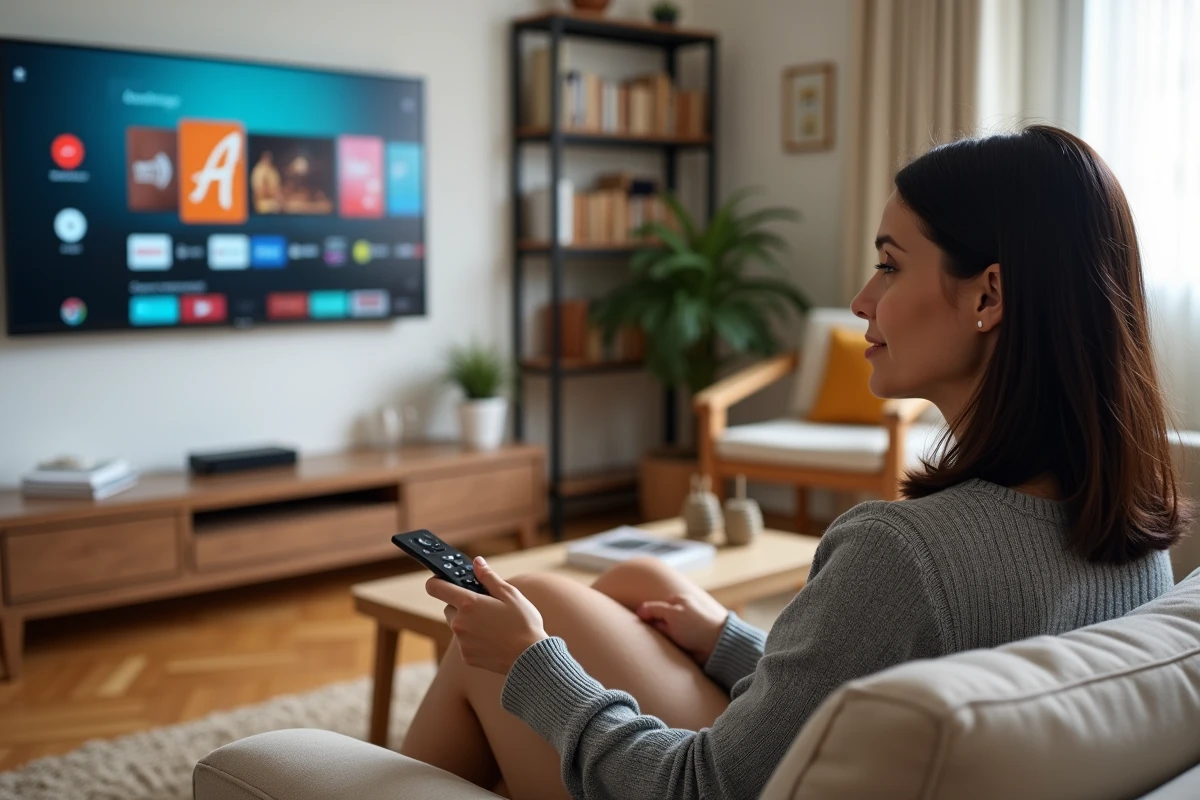
Thomson is now marketing Smart TVs under several operating systems, including Google TV on its latest models. The operation of a Thomson Smart TV relies on a software ecosystem that provides access to streaming applications, internet browsing, and voice control. Behind the promise of simplicity, the question of software longevity and fluidity over time deserves to be raised.
Software Tracking and Longevity of a Thomson Smart TV
The main commercial argument for Thomson Smart TVs revolves around access to applications and the simplicity of the interface. The available data does not allow us to conclude on the exact frequency of system updates distributed by Thomson on its Google TV models or on its older generations of Smart TVs.
This ambiguity is common among manufacturers that rely on a third-party system. With Google TV, it is Google that pushes updates for the application layer (Play Store, security patches). However, updates for the TV’s firmware (image calibration, audio management, panel drivers) remain the responsibility of Thomson.
Field reports vary on this point: some users notice a smooth interface after several months, while others report slowdowns on entry-level models whose processors struggle to keep up with system updates. A television sold with fast navigation in-store may behave differently after two years of successive updates.
To explore in detail the connection mechanism and network functions, the Thomson TV stick on Votre Journal describes the step-by-step operation of the connected system.
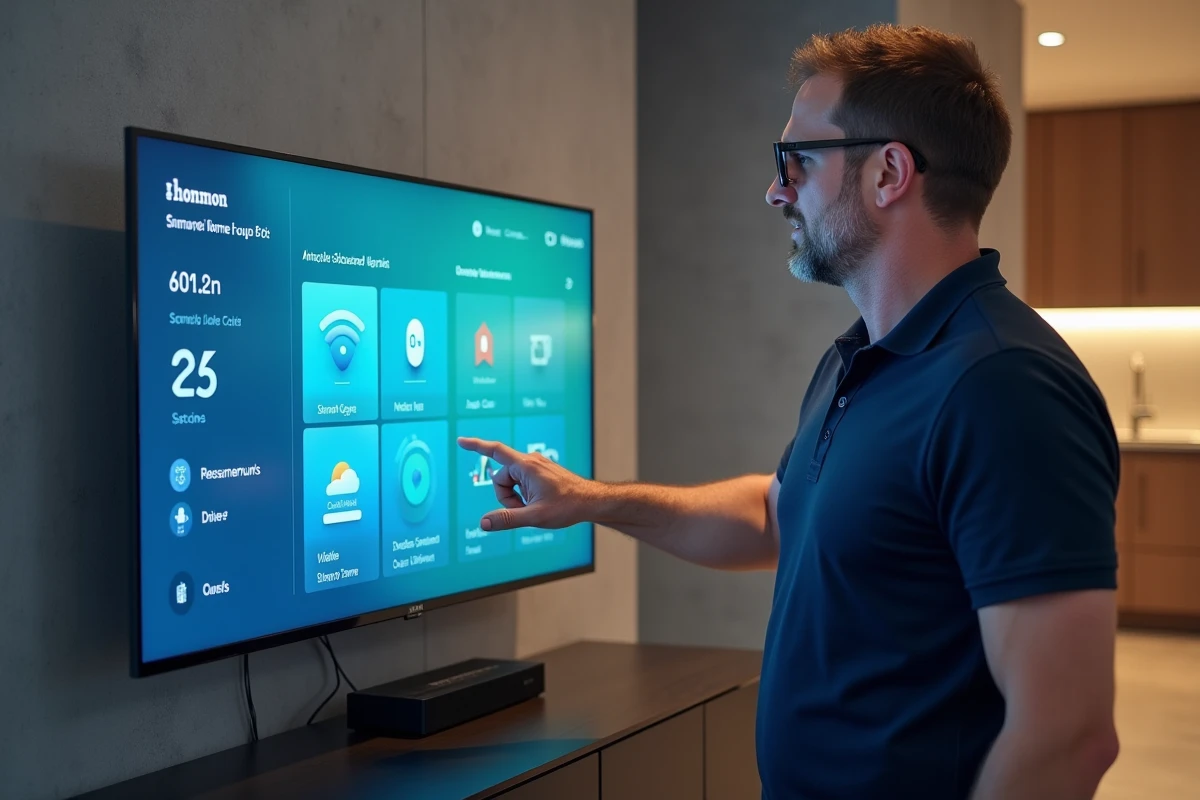
Google TV Ecosystem on Thomson: How the Interface Changes Daily Life
Google TV unifies access to content by aggregating catalogs from several streaming services onto a single home screen. On a Thomson Smart TV equipped with this system, Netflix, YouTube, and other platforms are accessible directly, without the need for an external box.
The interface offers personalized recommendations based on the viewing history of the associated Google account. This operation assumes a stable wifi connection and an active Google account, raising the question of data usage collection by the device.
Google Cast and Voice Control
Integrated Google Cast allows content to be sent from a phone or tablet to the TV screen, wirelessly. Google Assistant provides voice control to launch an application, adjust the volume, or search for a movie by title.
These functions depend entirely on the quality of the internet connection. An unstable wifi network degrades the experience to the point of making voice control unusable and casting erratic. Before investing in a Thomson Smart TV, checking the available bandwidth at the intended location of the TV remains a practical precaution.
Thomson Range: From Compact Screens to QD-MiniLED 4K
Thomson no longer offers a uniform range. The lineup is now structured around two distinct logics.
- Compact models (around 24 to 32 inches) with Full HD screens, designed for a bedroom, office, or small room where the viewing distance is limited. The Full HD resolution remains sharp at close range, where a 4K screen would not provide a visible gain.
- Living room televisions with classic LED panels, available in several intermediate sizes, which form the core range and target standard family use.
- High-end models incorporating display technologies like QD-MiniLED 4K, indicative of a recent upgrade that positions Thomson against historically more expensive competitors in this segment.
This diversification raises questions about the coherence of the positioning. Thomson now covers a very broad spectrum, from a secondary television under 200 euros to a premium model. The risk for the consumer is to assume a uniform quality of panel and image processing across the range, while the gaps between an entry-level LED model and a QD-MiniLED are considerable.

Thomson Smart TV in Professional Context: Hotels and Healthcare Facilities
A rarely discussed angle concerns the use of these televisions outside the home environment. Some Thomson Google TV models are marketed for settings such as hotels, residences, or clinics.
The integrated hotel mode allows for locking the TV settings and activating an automatic disconnection of streaming applications between each occupant. This function protects the privacy of previous clients’ Netflix or YouTube accounts, a recurring issue in the hospitality industry with consumer Smart TVs repurposed for communal use.
Centralized Management and Field Constraints
For an establishment deploying several dozen units, the ability to configure the televisions remotely simplifies maintenance. Field reports vary on the robustness of this centralized management depending on the models and the installed firmware versions.
The choice of a Thomson Smart TV in a professional context also depends on the relationship between the purchase price and the effective lifespan of the device. A television that receives updates for three years before being abandoned by the manufacturer poses a different profitability issue than that of an individual who changes televisions more frequently.
Connection and Troubleshooting Wifi on a Thomson Television
The majority of difficulties reported on Thomson Smart TVs concern the wifi connection. A television that regularly loses the network or displays long loading times on streaming applications quickly becomes frustrating.
- Check that the television is connected to the most suitable wifi band (the longer-range band for a device far from the router).
- Restarting the television and the router resolves a significant portion of intermittent disconnections.
- Prefer a wired Ethernet connection via the dedicated port, when wiring allows, for a stable 4K signal.
- Ensure that the television’s firmware is up to date, as some patches specifically target wifi stability.
A wifi connection problem is not always related to the television itself: the configuration of the home network, the distance to the router, and interference play a role at least as significant as the integrated wifi module in the device.
Thomson occupies a unique position in the Smart TV market: competitive prices, a Google TV ecosystem that ensures a solid application base, but legitimate questions about medium-term software support. Choosing a Thomson model is fully justified for targeted use (small room, hotel room, second screen), provided one does not expect the same software longevity as a manufacturer that also produces the operating system for its televisions.