Measuring who holds the largest land assets in France first requires agreeing on what is being measured. Built or unbuilt land, real estate portfolio or agricultural areas, public or private perimeter: depending on the chosen criterion, the ranking can change dramatically.
The French state consistently ranks at the top of available analyses, with an estimated portfolio of around 97 million m² and more than 195,000 buildings according to a Senate report. However, this figure only covers part of the country’s land reality.
Built land, unbuilt land, real estate assets: why the ranking depends on the definition
The confusion between land ownership and real estate assets runs through most public rankings. An owner of thousands of hectares of forests or agricultural land does not appear in the same databases as a manager of office towers or social housing.
Unbuilt land (agricultural land, forests, wasteland) represents the majority of the metropolitan territory. In contrast, built land concentrates most of the economic value. One hectare of cereal land in Beauce and one hectare of offices in La Défense have absolutely nothing in common in terms of assets, even though both fall under “land.”
To identify the landowner in France with the largest assets, it is therefore necessary to specify: are we talking about surface area owned, market value, or number of properties? Each of these indicators produces a different ranking.
| Measurement Criterion | Likely Top Ranking | Dominant Asset Type |
|---|---|---|
| Total Area (hectares) | State and local authorities | State forests, military land, unbuilt land |
| Built Area (m²) | Central state (ministries, operators) | Administrative buildings, universities, barracks |
| Market Value of Real Estate Portfolio | Large listed real estate companies (Unibail, Gecina, etc.) | Offices, shopping centers, logistics |
| Number of Housing Units Owned | Social landlords (entire sector) | HLM housing |
This table shows that no single actor dominates across all criteria simultaneously. The ranking entirely depends on the chosen perimeter.
The French State: the largest landowner by area and built assets
With its central administrations, operators, and public establishments, the state concentrates a considerable built portfolio. The Senate report mentions more than 195,000 buildings for around 97 million m². This perimeter includes ministries, universities, public hospitals, barracks, courts, and penitentiary buildings.
A point often absent from public rankings: public establishments of the state (national museums, grandes écoles, agencies) count in this total. Their weight reinforces the public sphere well beyond what the ministerial perimeter alone suggests.
Regarding unbuilt land, state-managed forests and military land add massive areas. Local authorities (municipalities, departments, regions) also hold considerable areas: roads, green spaces, sports facilities, school buildings. The combined state and local authorities would represent around 30% of the metropolitan territory.
Where this public asset is concentrated
In Île-de-France, the density of public buildings is at its maximum. The city of Paris alone holds a significant share of Parisian land, particularly through social housing and municipal facilities. Conversely, the largest public areas in hectares are found in rural and forested areas, far from urban centers.
Private Owners: Agricultural Land Dominates Everything Else
On the private side, agricultural and forestry operations cover the dominant share of the territory. Available estimates place private agricultural and forestry land at around half of the metropolitan area. No family, company, or holding competes individually with the state in terms of gross area.
- Large listed real estate companies (Unibail-Rodamco-Westfield, Gecina, Covivio) hold portfolios of high-value offices and retail spaces, but on relatively modest areas compared to agricultural land.
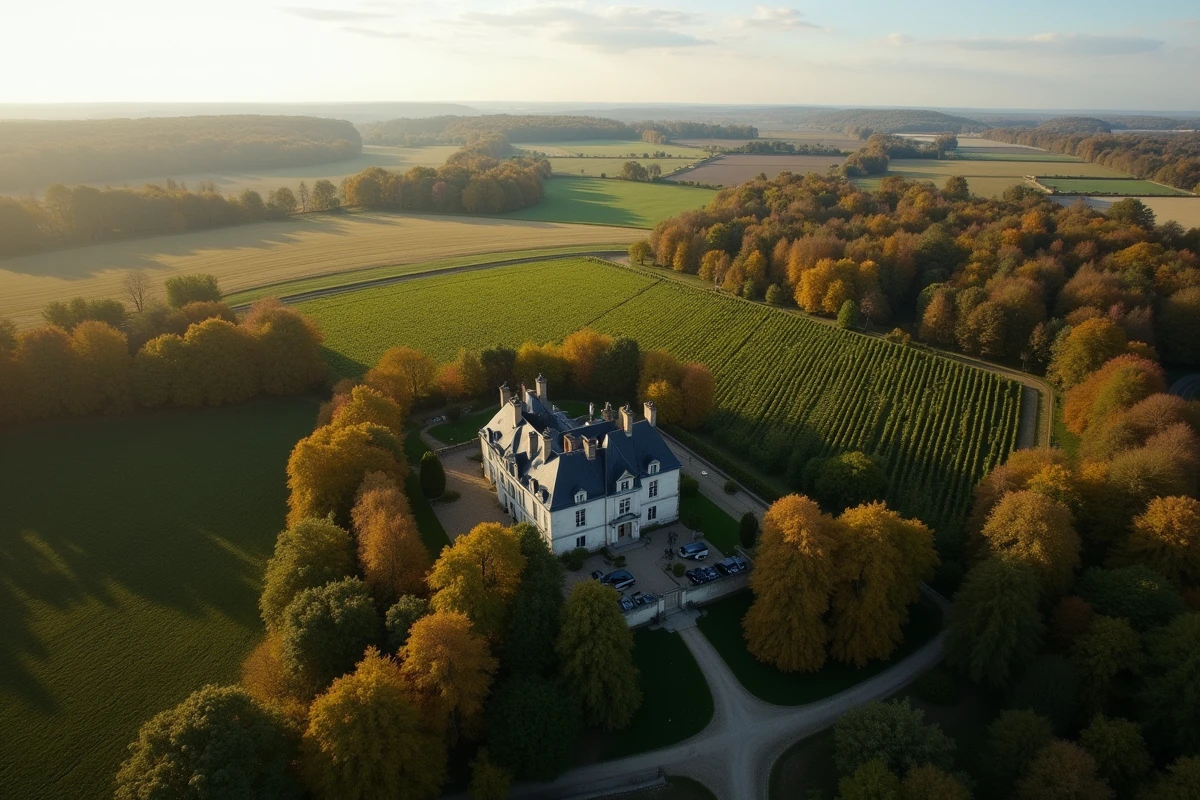
- Historical families and landed nobility sometimes retain estates of several thousand hectares, especially in forested and wine-growing areas, without these assets being centralized in accessible public databases.
- The Catholic Church remains a notable landowner with an estimated heritage of a few percent of the territory, consisting of places of worship, adjacent land, and agricultural properties inherited from the Ancien Régime.
No single private actor approaches the area held by public power. Private ownership is inherently fragmented among millions of households, operators, and companies.

Concentration of French Households’ Real Estate Assets
INSEE has highlighted a structural phenomenon: household real estate ownership is highly concentrated. Multiple property owners (households owning at least two homes) hold a predominant share of the portfolio.
This concentration does not translate into large land areas. Most multiple property owners hold apartments or individual houses, not estates of hundreds of hectares. The real estate wealth of households is measured in value, not in area.
Property Tax and Wealth Inequalities
INSEE also notes that property tax is regressive relative to asset value: the wealthiest households pay proportionally less than the less wealthy. In 2017, the average amount was 660 euros per housing unit. The top 10% of households with the highest real estate assets paid 37% of the total, but on a tax base that undervalues the real worth of their properties.
The answer to the initial question thus relies less on a name than on a framework for understanding. By area, the state dominates. By market value, listed real estate companies and multiple property owners concentrate the bulk. The largest landowner in France is the one chosen to be measured.